
Richland County Court Records After Arrest
After a Richland County jail arrest, the booking record and the court record serve different jobs. The jail record confirms that the person was booked into the Richland County Detention Center and may show a booked date, a booking photo, basic descriptors, and a local custody identifier. The court record is the formal criminal case. It can show a case number, filed counts, statutes, offense class, court dates, release or detention orders, warrants, pleas, dispositions, and sentence terms. The two records can overlap in time, but they are not the same file.
The court side begins when the Richland County State's Attorney's Office decides what charge to file or pursue in circuit court. Illinois counties use the State's Attorney title, not District Attorney. Official sources conflict on the current named officeholder, so the stable reference is the office itself: the Richland County State's Attorney's Office at the courthouse, phone 618-395-8444, email statesattorney@richlandcounty.illinois.gov. Current custody and booking fields belong with Richland County jail inmate records, while booking photographs are handled separately on the Richland County jail mugshots page.
Find Richland County Court Records
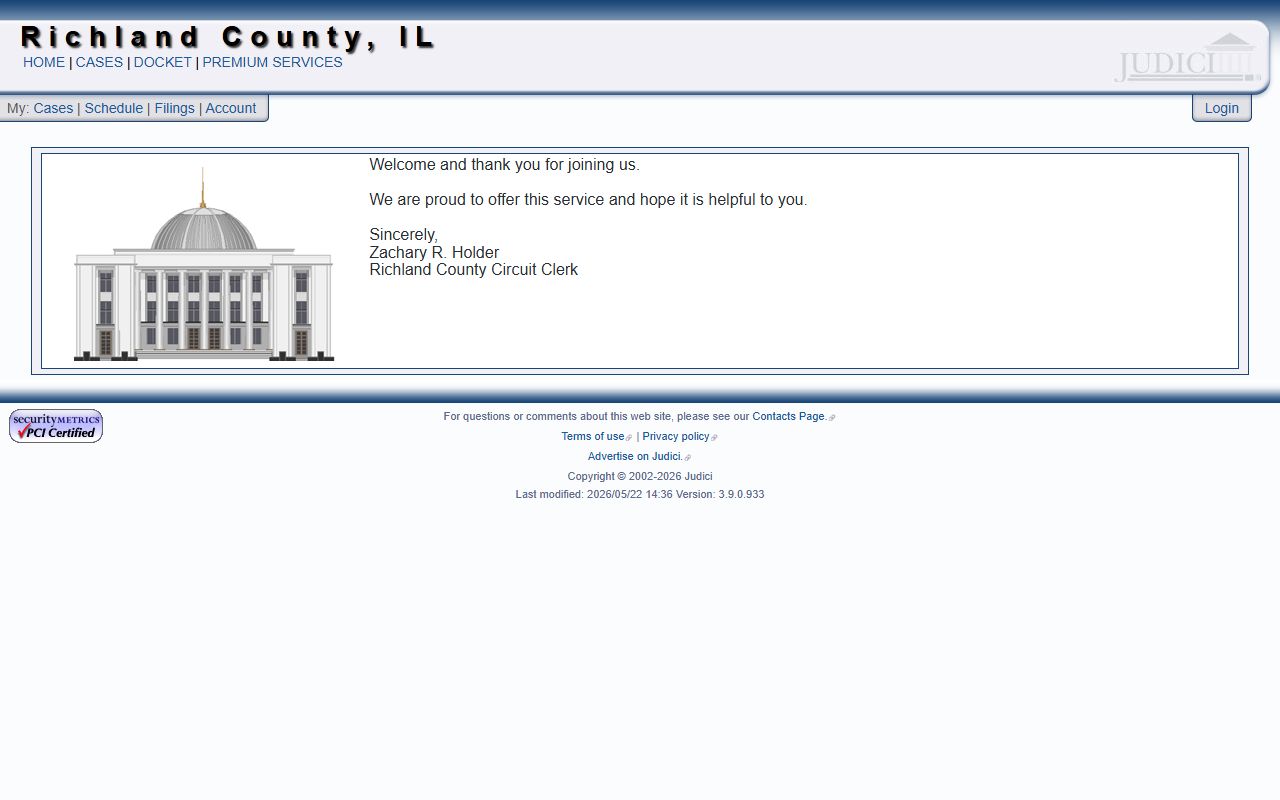
The main online path is Judici, the court portal used by Richland County and many other Illinois counties. The Richland County-specific Judici page identifies Zachary R. Holder as Circuit Clerk and is linked from the sheriff's important-links page as the place to search Illinois court cases, status, and dates. The Richland County Circuit Clerk site also points users to court-case search, daily docket, payments, directory, and remote court information.
- Open Judici and choose Richland County, Illinois, or go directly to the Richland County Judici court page.
- Search by defendant name when no case number is known. Use the case number if it appears on a court notice, warrant paperwork, citation, or clerk receipt.
- Open the public case entry and read the charge list, filing date, court dates, and status entries. Paid or account functions may appear for premium services.
- Compare court dates and release orders with jail custody only when needed. The jail does not set court dates; the court controls when detainees appear.
The Illinois Courts directory lists the Richland County Courthouse at 103 W. Main Street in Olney, Monday through Friday, 8:00 a.m. to 4:00 p.m., with the clerk phone 618-392-2151. It also notes an online records link, free parking around the courthouse, handicap spaces in back, an e-filing kiosk, a third-floor law library coordinated with the Circuit Clerk, and remote-proceedings information.
| Search field | Use | Richland County notes |
|---|---|---|
| Select Court | Required portal choice | Choose Richland County, IL for local circuit cases. |
| Defendant name | Name search | Best when the case number is not known. |
| Case number | Precise lookup | Use if listed on a clerk notice, warrant, citation, or docket entry. |
| Docket | Schedule check | Use for public court dates where the docket is available. |
| Premium services | Account tools | Judici notes that some services need paid subscription access. |
The official Judici Richland County page is the local court entry point shown in the research capture.
That portal is useful for filed court records, but it should not be read as a live jail roster or booking-photo gallery.
Jail Arrest to Court Case
A Richland County arrest usually starts with a law-enforcement agency taking a person to the Richland County Detention Center for booking. The jail verifies identity, records custody, and creates the booking entry. A first appearance or release decision can follow. The sheriff's court-appearance page says correctional staff do not schedule court appearances and take detainees to court only when the court advises them. Some appearances happen by closed-circuit television from inside the Detention Center.
The prosecutor then decides what charges to file. Those charges may match the arrest reason, but they can also be amended, reduced, added, or declined. Once the case is filed, the Circuit Clerk record becomes the main way to track the legal case. If a person is sentenced to the Illinois Department of Corrections, the sheriff's sentenced-to-prison page says adult males are transported to Graham Correctional Center and adult females to Logan Correctional Center.
| Document | What it does | How it differs from booking |
|---|---|---|
| Complaint | Starts or supports a criminal case after an arrest or citation. | It states a formal allegation for court, not just jail intake. |
| Information | A prosecutor-filed charging document in circuit court. | It reflects the State's Attorney's chosen filed charge. |
| Indictment | A grand-jury charging document for a criminal case. | It can replace or supersede earlier charge language. |
Richland County Charge Status
Charge status is the part of court records after a jail arrest that most often changes. A charge can be pending at filing, amended after review, reduced during plea talks, dismissed by court order, or disposed after a plea, bench trial, or jury verdict. A docket entry may also show a warrant issued after failure to appear. Because the public Richland County jail roster inspected did not show full charge values, Judici and the Circuit Clerk are the better sources for filed charge status.
| Status | Plain meaning | Search caution |
|---|---|---|
| Pending | The charge is still open in court. | Do not treat it as a conviction. |
| Amended | The charge language or count was changed. | Read the newest docket entry, not only the first charge. |
| Reduced | The filed offense was lowered or replaced. | The booking reason may look more severe than the final count. |
| Dismissed | The court ended that charge without conviction. | Other counts in the same case may still remain. |
| Disposed | The court has entered a final result for that count or case. | Read the disposition and sentence fields together. |
| Warrant issued | The court has ordered arrest, often after failure to appear. | Call the clerk or speak with counsel before taking action. |
Illinois law also separates arrest-report access from court-case access. 5 ILCS 140/2.15 covers listed arrest-report information held by criminal justice agencies, subject to public-safety and law-enforcement limits. 5 ILCS 140/3 gives the general Illinois FOIA response timeline for public bodies. Court files, however, are clerk records and may have separate court-access rules.
Bond and Release Orders
Bond and release orders are court records after arrest, even when the jail helps process payment or release. Illinois began its no-cash-bail system on September 18, 2023. The Richland County sheriff's bail page warns that older arrest warrants with a cash bond already assigned can still require bond to be posted. That creates a local two-track issue: newer pretrial decisions are handled under Illinois release and detention rules, while some previously issued warrants still carry money-bond instructions.
When a court has set a bond that can be posted, Richland County lists cash, certified check, and credit or debit card as accepted methods. Certified checks should be payable to the Richland County Circuit Clerk. Cash must be exact because the Detention Center does not keep cash on hand for change. Courtmoney can take remote card payments by phone at 1-800-352-9870 using county code IL 13706, and the sheriff's page says Courtmoney charges a 7 percent fee. A detainer or outside warrant can still block release.
| Release record | What it means in Richland County |
|---|---|
| No-cash-bail decision | For new Illinois cases, the court decides release or detention without setting money bail as the normal path. |
| Older warrant bond | RCSO says previously issued warrants with cash bond remain valid and must be posted when applicable. |
| Certified check | Payable to the Richland County Circuit Clerk when bond is allowed. |
| Credit or debit card | Accepted through the local process or Courtmoney, with a service fee noted by RCSO. |
| Hold or detainer | A separate agency or jurisdiction can keep custody in place after local release terms are met. |
Warrants After Court Arrest Records
No official Richland County active warrant search was found in the sheriff website, county website, Judici page, or OCV manifest during research. The sheriff platform has a Most Wanted feature, but it was not documented as a searchable active-warrant database. For court-record work, bench warrants and failure-to-appear warrants are usually case-specific. Judici, the Circuit Clerk, and direct court contact are the right channels for public case entries.
Use the Detention Center at 618-395-7483 for current custody and booking questions, the sheriff business line at 618-395-7481 for office routing, dispatch non-emergency at 618-393-2921 for non-emergency law-enforcement contact, and the Circuit Clerk at 618-392-2151 for court-record direction. An active warrant can lead to arrest. Legal advice should come from an attorney, not from a search result.
Charges, Convictions, Sealing
A charge is an accusation filed in court. A conviction is a result after a guilty plea, guilty verdict, or other conviction entry. Richland County court records after a jail arrest may show both, but the words should not be blended. Illinois criminal-history and expungement rules also distinguish between public visibility, sealed access, and expunged records.
| Question | Charge | Conviction |
|---|---|---|
| Stage | Filed allegation after arrest or citation. | Final criminal finding or plea result. |
| Proof | Based on filing rules and probable cause concepts. | Requires plea or proof beyond a reasonable doubt. |
| Record meaning | Can be pending, amended, dismissed, or disposed. | Can affect sentence, fines, custody, and later criminal-history records. |
Under the Illinois Criminal Identification Act, expungement and sealing depend on the charge, disposition, timing, and statutory eligibility. Petitions are generally filed in the circuit court where the arrest occurred or charges were brought. The Illinois State Police Bureau of Identification explains criminal-history records and the concepts of expungement and sealing.
| Record action | Public effect | Limit |
|---|---|---|
| Sealed | Hidden from most public searches. | Some law-enforcement, court, or authorized users may still have access. |
| Expunged | Removed or treated as though it did not occur for many public purposes. | Eligibility is narrow and must be ordered through the court process. |
| Not eligible | Remains public unless another rule restricts access. | The case result and statute control the answer. |
Important: Court and jail lookup information is not a consumer report and must not be used for FCRA-covered screening.
Restricted Richland County Court Records
Not every court record after arrest is fully public. Juvenile matters, sealed cases, expunged records, protected victim information, some pending-investigation details, and security-sensitive jail information may be withheld or limited. Illinois FOIA also allows withholding certain arrest-report details when disclosure would interfere with law-enforcement proceedings, endanger a person, or compromise correctional security.
For a complete record, use the originating office. The sheriff or jail handles custody and booking requests. The Circuit Clerk handles public court files and docket questions. IDOC handles state-prison records after sentence and transfer. BOP and ICE locators cover separate federal or immigration custody, not Richland County circuit cases.